
JC H1 & H2 Physics Tuition in Singapore
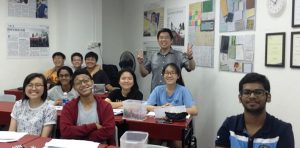
Our H1 & H2 Physics tuition programme is tailored to help JC students develop a deeper understanding of Physics concepts, master problem-solving techniques, and excel in their academic performance. Our success stems from our tried-and-tested teaching methods, comprehensive resources, and personalised guidance that aims to help each student achieve desired results in the JC Physics exams. As one of the most essential and fundamental fields of science, Physics plays a crucial role in many industries and careers. It is therefore important for students to develop a strong foundation in this subject. Join us on this educational journey, and let us help you achieve your academic goals!
JC H2 Physics Syllabus
| 1. Measurement | 2. Forces and Moments |
| • Physical quantities and SI units • Errors and uncertainties • Scalars and vectors | • Types of force • Moment and torque • Translational and rotational equilibrium |
| 3. Motion and Forces | 4. Energy and Fields |
| • Kinematics • Uniformly accelerated linear motion • Mass and linear momentum • Laws of motion | • Energy stores and transfers • Work done by a force • Kinetic energy • Concept of a field • Potential energy • Power and efficiency |
| 5. Projectile Motion | 6. Collisions |
| • Free fall • Gravitational potential energy in a uniform field • Effects of air resistance | • Impulse • Conservation of momentum and energy |
| 7. Circular Motion | 8. Gravitational Fields |
| Kinematics of uniform circular motion • Centripetal acceleration | • Newton’s laws of gravitation • Gravitational field strength • Gravitational potential and energy • Escape velocity and circular orbits |
| 9. Oscillations | 10. Wave Motion |
| • Simple harmonic motion • Energy in oscillations | • Properties of waves • Energy transfer by progressive waves • Polarisation |
| 11. Superposition | 12. Temperature and Ideal Gases |
| • Principle of superposition • Standing waves • Interference of two or more point sources • Diffraction through a finite-size gap | • Empirical gas laws • Kinetic theory of gases |
| 13. Thermodynamic Systems | 14. Electric Fields |
| • Internal energy • Heating and work done • Laws of thermodynamics • Specific heat capacity and specific latent heat | • Coulomb’s law • Electric field strength • Electric potential and energy • Uniform electric fields • Capacitance |
| 15. Currents | 16. Circuits |
| • Current and drift velocity • Potential difference and power • Power supplies: d.c. and a.c. | • Circuit symbols and diagrams • Resistance, resistivity and internal resistance • Resistors in series and parallel • RC circuits with d.c. source |
| 17. Electromagnetic Forces | 18. Electromagnetic Induction |
| • Magnetic fields and magnetic flux density due to currents • Force on a current-carrying conductor • Force on a moving charge | • Magnetic flux • Faraday’s and Lenz’s laws of electromagnetic induction • Power transformers |
| 19. Quantum Physics | 20. Nuclear Physics |
| • The particulate nature of light • The wave nature of particles • Quantisation of energy in matter | • The nuclear atom • Radioactive decay • Nuclear processes and conservation laws • Mass defect and nuclear binding energy |
JC H2 Physics Assessment Exam
| Paper | Type | Duration | Score | Weightage |
|---|---|---|---|---|
| 1 | Multiple Choice | 1 Hour | 30 | 15% |
| 2 | Structured Questions | 2 Hours | 75 | 30% |
| 3 | Longer Structured Questions | 2 Hours | 75 | 35% |
| 4 | Practical | 2.5 Hours | 50 | 20% |
JC H1 Physics Syllabus
| 1. Measurement | 2. Forces and Moments |
| • Physical quantities and SI units • Scalars and vectors • Errors and uncertainties | • Type of forces • Moment and torque • Translational and rotational equilibrium |
| 3. Motion and Forces | 4. Energy and Fields |
| • Kinematics • Uniformly accelerated linear motion • Mass and linear momentum • Laws of motion | • Energy stores and transfers • Work done by a force • Kinetic energy • Concept of a field • Potential energy • Power and efficiency |
| 5. Projectile Motion | 6. Collisions |
| • Free fall • Gravitational potential energy in a uniform field • Effects of air resistance | • Impulse • Conservation of momentum and energy |
| 7. Circular Motion | 8. Currents |
| • Kinematics of uniform circular motion • Centripetal acceleration • Newton’s laws of gravitation • Circular orbits | • Current and drift velocity • Potential difference and power |
| 9. Circuits | 10. Electromagnetism |
| • Circuit symbols and diagrams • Resistance, resistivity and internal resistance • Resistors in series and in parallel | • Uniform electric fields • Magnetic fields and magnetic flux density due to currents • Force on a current-carrying conductor • Force on a moving charge |
| 11. Nuclear Physics | |
| • The nuclear atom • Radioactive decay • Nuclear processes and conservation laws • Mass defect and nuclear binding energy |
JC H1 Physics Assessment Exam
| Paper | Type | Duration | Score | Weightage |
|---|---|---|---|---|
| 1 | Multiple Choice | 1 Hour | 30 | 33% |
| 2 | Structured Questions | 2 Hours | 80 | 67% |
Frequently Asked Questions
The frequency of attending JC Physics tuition largely depends on your individual needs, schedule and academic goals. If you are struggling with H1 or H2 Physics and need additional help, attending tuition on a more regular basis may be beneficial. This will allow you to have more time and attention to work through challenging concepts, practice problem-solving techniques, and receive feedback from your tutor. On the other hand, if you are already performing well in the subject, attending tuition less frequently, may be sufficient to maintain your level of understanding and preparation for examinations as a supplement to your regular studies. Ultimately, it is important to find a balance that works best for you, you can work with your tutor to determine what frequency of sessions will be most beneficial for you.
H1 Physics is a less advanced course compared to H2 Physics, with a lighter workload and less emphasis on higher-level concepts. In addition, H1 Physics covers a smaller range of topics, with fewer practical components compared to H2 Physics, and the depth of coverage is not as extensive.
We take a focused approach to help students excel in their A-Level Physics exams:
Syllabus-Aligned Curriculum: Our lessons cover the entire A-Level syllabus systematically, building a solid foundation and progressing to advanced topics.
Practice with Past-Year Papers: Students regularly work on past exam questions to familiarize themselves with the format and improve time management and accuracy.
Exam Techniques: We teach critical thinking and problem-solving strategies, ensuring students understand key concepts and can apply them effectively in exams.
Revision and Drills: Intensive revision sessions focus on frequently tested topics, while topical drills reinforce understanding and help avoid common mistakes.
Personalized Feedback: Continuous assessments and mock exams allow us to track progress and provide targeted feedback to address individual weaknesses.
Time Management and Confidence Building: We equip students with time management skills and stress-relief techniques to approach the exam with confidence and calm.
