
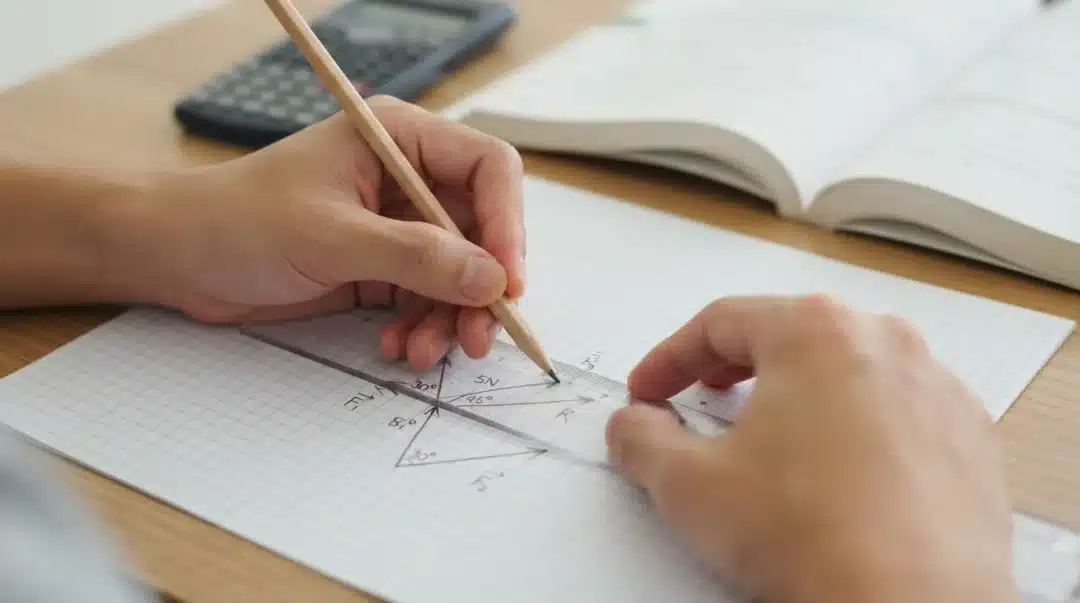
The Single Biggest Misconception in SEC G3 Physics
The most common mistake we see in Secondary Physics is students treating forces like simple numbers and adding them together directly. In reality, forces are vectors with both magnitude and direction, and failing to grasp this concept leads to significant mark loss in exams, especially in Dynamics questions.
As Secondary 3 students begin their journey towards the 2027 SEC exams, correcting this fundamental misunderstanding is the first critical step to building a strong foundation in Physics. This isn’t just about memorising a formula. It’s about changing the way students see and solve problems involving forces.
Why Can’t I Just Add Forces Like 5 N + 10 N = 15 N?
The short answer: because direction matters. A force of 10 N pushing an object to the right has a very different effect from a 10 N force pushing it upwards. Quantities that only have a size (magnitude) are called scalars. Think of mass or time. Forces, however, are vectors.
Imagine walking 10 metres east and then 5 metres north. You haven’t travelled 15 metres from your starting point. You are a specific distance and direction away, a position that requires both numbers to describe. Forces work in exactly the same way. Simply adding their magnitudes (5 N + 10 N) without considering their directions is like ignoring whether you walked north or east. It leads to a wrong answer.
The “Scalar Trap”: 3 Common Mistakes in Secondary Physics Exams
This single misconception creates a domino effect of errors. Based on years of analysing exam scripts and feedback from educators, here are the three most frequent mistakes students make.
Mistake 1: Direct Addition of Angled Forces
This is the most direct symptom of the myth. A student sees a diagram with a 10 N force acting at 30 degrees and another 5 N force acting at 90 degrees and tries to add or subtract them. This is fundamentally incorrect. Forces acting at angles must be combined using vector addition rather than simple arithmetic.
Mistake 2: Errors in Scale Drawings and Direction Signs
Even when students know forces are vectors, mistakes are common. They often mismanage positive and negative signs for opposite directions (e.g. treating ‘up’ and ‘down’ forces as both positive) or draw inaccurate scale diagrams without clear arrows and angles. These errors stem from a shaky conceptual grasp of how vectors are represented.
Mistake 3: Neglecting the Free-Body Diagram (FBD)
As often discussed on online student forums, many students jump straight into calculations without drawing a clear free-body diagram. The FBD is the most critical tool for visualising all forces acting on an object. A poorly drawn or non-existent diagram almost guarantees errors because the directions and angles are not clearly defined.
What Does the MOE Syllabus Actually Require for the 2027 Exams?
The Singapore-Cambridge Secondary Education Certificate (SEC) G3 Physics syllabus (code K323) is very clear on this topic. Under Physical Quantities, Units and Measurement—and applied directly in Dynamics—SEAB expects students to be able to “state what is meant by scalar and vector quantities” and “add two vectors to determine a resultant by a graphical method”.
This isn’t an obscure or minor detail. It is a foundational skill that is tested explicitly and is required to solve more complex problems involving Newton’s Laws of Motion, work done and equilibrium. There are no shortcuts around it.
A 3-Step Routine to Master Force Vectors
To avoid the scalar trap, students should follow a disciplined, three-step process for every force problem. This methodical approach builds good habits and prevents careless mistakes under exam pressure.
- Always start with a free-body diagram (FBD): Isolate the object of interest and draw all forces acting on it. Label each force (e.g. weight, tension, friction and normal contact force) and any relevant angles clearly. This is your map for the entire problem.
- Choose the right vector addition method: Look at your FBD. If the forces act along the same line, assign positive and negative signs for opposite directions. If they act at right angles, use Pythagoras’ theorem and trigonometry (SOH CAH TOA). For forces at other angles, draw a scaled vector diagram using the parallelogram or tip-to-tail method.
- State both magnitude and direction: Measure or calculate the final resultant force carefully. Always check that your final answer includes both the size of the force (in newtons) and its direction relative to a reference line.
Recognising these mistakes is one thing but consistently applying the correct method under pressure is another. When a student repeatedly makes the same sign or angle error, it often signals a deep-seated misconception that is difficult to self-correct. This is where structured guidance from specialist Secondary Physics tuition becomes invaluable, offering targeted practice and immediate feedback on worked solutions to fix these persistent errors.
Conclusion: Building a Solid Foundation for SEC G3 Physics and Beyond
The myth that forces can be treated like simple numbers is a significant hurdle for many Secondary Physics students. Mastering force vectors is not just about passing one topic. It’s a non-negotiable skill that underpins much of the syllabus for the 2027 SEC G3 Physics exams and prepares students for the A-Level H2 Physics (9478) curriculum, where full trigonometric resolution of forces is introduced.
By focusing on conceptual understanding, practising a disciplined problem-solving routine and seeking help to correct recurring errors, students can turn this common point of failure into a source of confidence. Understanding these concepts is the first step but consistent, expert-guided practice makes the difference for exam performance. Parents and students interested in exploring specialised Secondary Physics tuition can learn more about structured programmes on our website.
Building strong study habits takes patience, especially when academic demands pick up. If your child needs an extra hand making difficult topics click, Geniebook offers targeted support across every stage. Find AI-personalised worksheets and live classes for primary and secondary school at geniebook.com, comprehensive secondary, IB and JC subject tuition at afterskool.edu.sg or dedicated physics masterclasses at tuitionphysics.com and bestphysicstuition.com.
Frequently Asked Questions
Why do I get SEC G3 Physics marks deducted for simply adding forces together?
You lose marks because forces are vectors, not scalars, meaning they have both magnitude and direction that must be accounted for in calculations. Simply adding forces like 5 N + 10 N = 15 N ignores the specific angles at which these forces act, which is a fundamental misunderstanding that SEAB penalises in Secondary Physics exams.
What is the most important tool for solving force problems in Secondary Physics?
The free-body diagram (FBD) is the most critical tool for solving force problems because it visualises all forces acting on an object, including their directions and angles. Skipping the FBD often leads to errors in vector addition, making it much harder to accurately calculate the resultant force.
How do I find the resultant of two angled forces in SEC G3 Physics questions?
To find the resultant of two forces acting at an angle, draw a scaled vector diagram using either the parallelogram method or the tip-to-tail method. If the two forces are perpendicular to each other, you can also use Pythagoras’ theorem and basic trigonometric ratios to find the magnitude and direction of the resultant force.
Is vector addition required by the Singapore MOE Physics syllabus?
Yes, the Singapore-Cambridge SEC G3 Physics syllabus (K323) explicitly requires students to add two vectors to determine a resultant by a graphical method. This skill is foundational for solving complex problems involving Dynamics, Newton’s Laws of Motion and work done.
How can Secondary Physics tuition help with force vector problems?
Specialised Secondary Physics tuition helps students by identifying persistent conceptual errors, such as misdrawing vector diagrams or mishandling negative signs for opposing directions. Through structured, expert-led practice and immediate feedback, students can correct these deep-seated misconceptions that are difficult to fix through self-study alone.

