
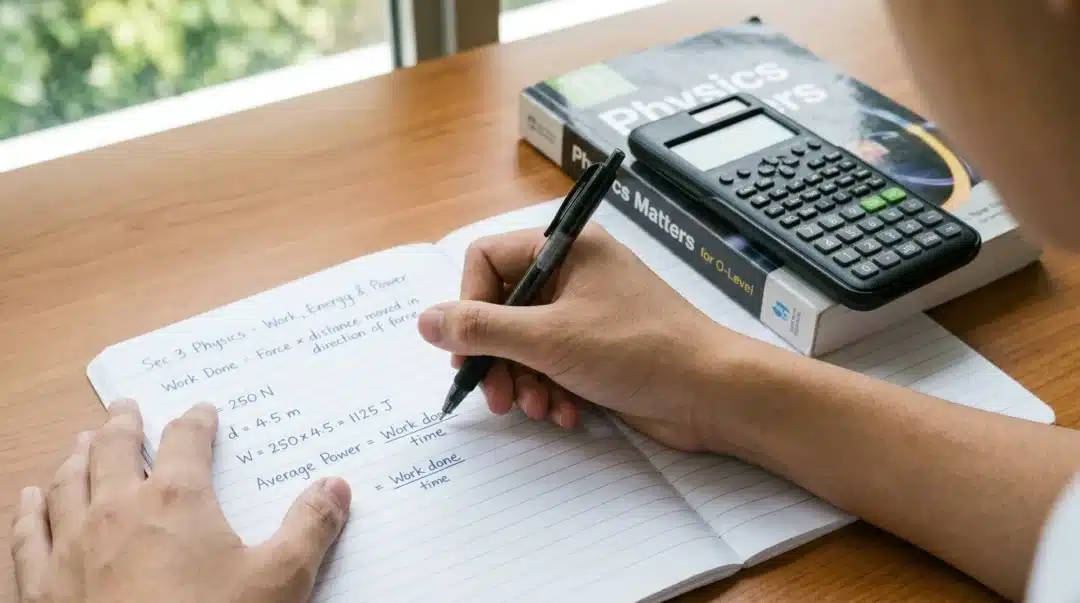
Why Energy, Work and Power Problems Trip Up Students
The concepts of energy, work and power are foundational in the Singapore-Cambridge Secondary Education Certificate (SEC) G3 Physics syllabus (code K323, replacing GCE O-Level code 6091 from 2027). Yet they are a frequent source of lost marks. Many students can recite the definitions but struggle to apply them when a question presents a slightly unfamiliar scenario, like a roller coaster moving along a track with friction. The core challenge lies in differentiating between these three related but distinct concepts. Is the question asking for the rate of energy transfer (power), the total energy transferred (work) or the state of motion (kinetic energy)? This initial confusion often leads to selecting the wrong formula and a cascade of errors.
The Trap of Rote Memorisation
Simply memorising formulae like Ek = ½mv2 or Ep = mgh isn’t enough. Examiners design questions that test understanding, not just recall. For example, a student might correctly calculate the loss in gravitational potential energy as an object falls but forget to account for the work done against air resistance when asked to find the final kinetic energy. This shows a gap in applying the principle of conservation of energy, a key learning outcome in the MOE syllabus. Success in Secondary Physics requires linking these formulae to the underlying principles.
The 4-Step Workflow That Prevents Common Mistakes
Top-scoring students don’t just jump into calculations. They use a systematic workflow to deconstruct problems and avoid careless errors. This structured approach is what we reinforce constantly, as it builds confidence and accuracy under exam pressure.
- Step 1: Decode and Visualise. Read the question carefully to identify all given quantities and the final unknown. Draw a simple diagram, especially for problems involving forces, heights and motion. This visual aid helps clarify the situation, such as identifying all forces acting on an object.
- Step 2: Select the Right Principle and Formula. Is energy being conserved? Is work being done by a specific force? Is the rate of work required? Your answer determines the formula. Because SEAB does not provide a formula sheet in the O-Level or SEC G3 Physics exam, students must recall key equations accurately and focus on how to apply them. For instance, knowing that power is the rate of work done (P = W/t) and work done is force times distance (W = Fd) helps derive P = Fv for an object moving at a constant velocity.
- Step 3: Conduct a Meticulous Unit Check. This is a non-negotiable step. Standard mechanics formulae require SI units to yield answers in joules (J) and watts (W). Unless a question specifies otherwise (such as kWh in practical electricity), convert quantities before calculating: grams to kilograms (kg), centimetres to metres (m) and minutes to seconds (s). A simple unit conversion error can cost all the marks for a question.
- Step 4: Review for Reasonableness. After finding an answer, pause and ask: does this make sense? A car’s power output shouldn’t be a few watts, and a person walking up stairs shouldn’t be expending megawatts of power. This final sanity check can catch significant calculation errors.
What Are Examiners Looking For in the 2027 SEC Physics Exams?
Examiners reward clear thinking and logical communication, not just the final correct answer. In Paper 2 (Structured and Free Response), where most energy and power problems appear, method marks are crucial. Students must show their working, starting from the principle or formula they are using. It tells the marker that the student understands the physics, even if they make a small calculation slip. The syllabus also emphasises practical applications, so expect questions framed around real-world contexts like the efficiency of electric motors or the power needed to operate a lift.
Many students lose marks not from a lack of knowledge but from small, repeated errors in their problem-solving steps, such as consistently misapplying the principle of conservation of energy when friction is present. Without an expert to review their working and pinpoint these blind spots, these habits can become ingrained. Structured guidance from a specialist in Secondary Physics tuition can provide the necessary feedback to break these cycles before the SEC exams.
How to Build Mastery and Confidence
Consistent practice is the only way to internalise the 4-step workflow. Here’s a focused approach:
- Use Past Year Papers (PYPs): Work through papers from 2020–2026, paying closest attention to 2024–2026 papers which reflect the current syllabus format. This is the best way to get familiar with the question style, scope and difficulty level set by SEAB.
- Focus on Weaknesses: After completing a paper, don’t just mark the score. Analyse the mistakes. Were they conceptual errors, calculation mistakes or unit conversion issues? This analysis guides future revision.
- Consult MOE-Approved Textbooks: These books are aligned with the syllabus and provide good foundational explanations and worked examples.
Mastering these topics in Secondary Physics is not just about the SEC exams. It builds the analytical framework required for more advanced studies, including A-Level H2 Physics. By focusing on a systematic approach and understanding the ‘why’ behind the formulae, your child can turn a challenging topic into a source of confidence. Building these skills takes consistent effort and the right guidance. To see how specialised support can help your child master these concepts, you can explore the programmes offered by Best Physics Tuition.
Building strong study habits takes patience, especially when academic demands pick up. If your child needs an extra hand making difficult topics click, Geniebook offers targeted support across every stage. Find AI-personalised worksheets and live classes for primary and secondary school at geniebook.com, comprehensive secondary, IB and JC subject tuition at afterskool.edu.sg or dedicated physics masterclasses at tuitionphysics.com and bestphysicstuition.com.
Frequently Asked Questions
Why do students struggle with energy and power physics problems in the SEC and O-Level exams?
Students often struggle with energy and power problems because they fail to differentiate between kinetic energy, work done and power, which leads to selecting the incorrect formula. While many students can recite definitions, they struggle to apply the principle of conservation of energy when faced with unfamiliar scenarios like friction or air resistance. This is often exacerbated by relying on rote memorisation of formulae rather than understanding the underlying physics principles required for the Singapore-Cambridge SEC G3 Physics exam.
What is the 4-step workflow for solving Secondary Physics problems?
The 4-step workflow involves decoding and visualising the problem, selecting the correct principle and formula, conducting a meticulous unit check and reviewing the answer for reasonableness. First, students should draw diagrams to identify forces. Second, they determine whether the scenario involves conservation of energy or work done. Third, they must convert all values into standard SI units where required. Finally, they perform a sanity check to ensure the calculated answer makes physical sense.
How should students prepare for the energy and power section of the SEC Physics exam?
Students can prepare for SEC Physics exams by working through past year papers from 2020 to 2026, focusing especially on 2024 to 2026 papers which match the current syllabus format, to familiarise themselves with the SEAB question style and scope. It is essential to analyse mistakes rather than just checking scores, distinguishing between conceptual gaps, calculation errors or unit conversion mistakes. Using MOE-approved textbooks to review foundational concepts and worked examples is also a highly effective way to build mastery.
Are there any specific unit conversion tips for Secondary Physics?
Meticulous unit conversion is a non-negotiable step in Secondary Physics because standard mechanics formulae require SI units to yield answers in joules and watts. Unless a question specifies another unit such as kWh, students must convert all given quantities into standard units before starting any calculation, such as changing grams to kilograms, centimetres to metres and minutes to seconds. Failing to convert units correctly often results in losing all marks for a question even if the formula application is correct.
Does mastering energy and power help with later studies like JC H2 Physics?
Yes, mastering these foundational topics provides the analytical framework required for more advanced studies including A-Level H2 Physics. The systematic approach to problem-solving and understanding the relationship between energy, work and power allows students to handle complex concepts with greater confidence. Building these skills early is essential for academic progression beyond the secondary level.
What do examiners look for when marking work, energy and power formula questions?
Examiners look for clear thinking and logical communication, particularly in Paper 2 structured and free-response questions where method marks are crucial. Students must show their working, starting from the relevant principle or formula, to demonstrate an understanding of the physics involved. Even if a small calculation slip occurs, showing the correct method can often salvage marks for the student.

